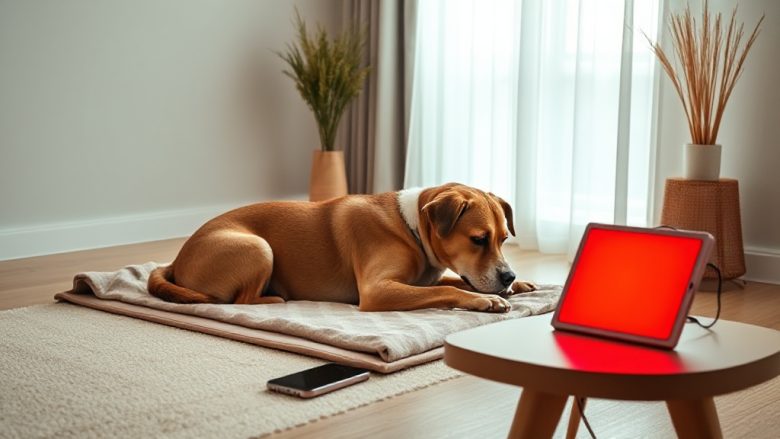
The lamp is small, about the size of a hardback book, and it throws a dull red circle onto the rug. My dog, a nine-year-old lab cross with a stiff back leg, lies on her side with her nose pointed away from it. I have a timer running on my phone. Ten minutes. That is the whole ritual. It looks like nothing is happening, which is exactly why so many owners give up before they see a result.
I am not a vet and I am not selling anything. I started using red light therapy for dogs after a physio suggested it for post-surgery swelling, and I have kept going because the changes were small but real. This post is about making that ten-minute scene safe and repeatable, so you are not guessing at power settings or holding the lamp too close because it feels like it should be doing more.
What Red Light Therapy for Dogs Actually Does
Red light therapy, sometimes called photobiomodulation, uses visible red and near-infrared light to penetrate skin and tissue. The wavelengths that matter most sit roughly between 600 and 1,100 nanometres. Red light around 630 to 660 nm mostly affects the surface, while near-infrared around 810 to 850 nm reaches deeper into muscle and joint tissue. The light is absorbed by mitochondria, the energy factories inside cells, and the working theory is that this nudges them to produce more ATP while calming oxidative stress. That is a mechanism, not a miracle.
What owners tend to notice is reduced stiffness, less licking at a sore spot, and a dog that gets up more easily after a rest. What it will not do is fix a torn cruciate ligament, cure arthritis, or replace pain medication prescribed by your vet. Think of it as a support tool. It works best alongside proper veterinary care, weight management, and controlled exercise, not instead of them.
The evidence base is growing but uneven. Some studies in dogs show measurable improvements in wound healing and joint comfort. Others are small or poorly controlled. I would rather you go in expecting a modest, gradual effect than a dramatic overnight change. If a seller promises a cure, walk away.
Setting Up a Safe Session at Home
The first thing to sort out is the device itself. You want a lamp or panel with a stated wavelength, ideally in the 630 to 850 nm range, and a way to control dose. Cheap units often list vague “red light” claims with no numbers. If there is no wavelength and no irradiance figure, you cannot calculate a safe dose, and you are guessing every time.
Check the device for a few specific things before you use it on your dog. Look for a cooling fan or heat sink, because near-infrared panels can get warm and you do not want to press a hot surface against thin skin. Check that the beam is wide enough to cover the treatment area without you having to hold it in one spot for twenty minutes. And check the timer function, because consistency matters more than intensity.
Distance is where most owners go wrong. Holding the lamp two centimetres from the skin concentrates the dose and risks overheating. A more sensible starting point is five to fifteen centimetres, depending on the device’s stated output. If the manufacturer gives a treatment time for humans, do not assume it transfers directly to a dog. Smaller bodies, thinner skin, and less fur in some areas all change how much light reaches the tissue.
Here is the sequence I use, and it has stayed the same for months because it works.
First, brush the area gently. Fur blocks a lot of light, especially dense double coats. You do not need to shave, but parting the coat and cleaning away dirt helps. Second, set up somewhere your dog already likes to lie down. A mat, a bed, the same corner every time. Third, switch the lamp on and let it warm up for a minute away from the dog so there are no surprises. Fourth, hold or position the lamp at the recommended distance and start the timer. Ten minutes per area is a reasonable starting point for most consumer devices, but follow your device’s guidance. Fifth, stay with your dog the whole time. This is not a leave-it-running treatment.
Watch your dog, not the clock. If they shift away, pant, or look at the lamp with suspicion, stop and try a shorter session next time. Some dogs fall asleep under it. Others tolerate three minutes and then want to leave. Both are normal.
Safety Checklist Before Every Session
Run through this in your head each time. It takes thirty seconds and prevents most problems.
Eyes first. Never point the lamp at your dog’s face or let them stare into it. If you are treating the neck or shoulder, angle the beam away from the head and consider dog goggles, which exist and are not as silly as they sound. The same goes for your own eyes. Do not look directly into the emitter.
Skin second. Check the treatment area for cuts, rashes, hot spots, or moles that have changed. Do not treat broken skin, active infections, or anything your vet has not cleared. Do not treat over the thyroid gland, over the eyes, or over a pregnant abdomen. If your dog has cancer or a history of it, ask your vet before starting, because light stimulates cell activity and you want a professional opinion on whether that is appropriate.
Medications third. Some drugs make skin more sensitive to light. If your dog is on anything photosensitising, get advice first. This is a short conversation with your vet, not a research project.
Heat fourth. Touch the lamp housing after a few minutes. If it is uncomfortable against your own inner wrist, it is too hot for your dog. Move it further away or shorten the session. Never leave a lamp resting on a dog, and never use one while your dog is unattended or asleep in a position where they could roll onto it.
Finally, keep sessions short and spaced. Once a day is plenty for most home setups. Twice a day is sometimes suggested for acute issues, but more is not better. Tissue needs time to respond.
Signs It Is Working and Signs to Stop
Improvement with red light therapy is usually slow and easy to miss. The first thing I noticed was not pain relief but behaviour. My dog started lying down on the treated side instead of always favouring the other one. A week later she was getting up from the floor without that little pause. Those are the kinds of signs to look for: less shifting, less licking, easier stairs, a longer walk before she slows down, a better mood in the evening.
Keep a simple log. Date, area treated, session length, and one sentence about how she moved that day. After two or three weeks you will have something to look back at, and you will not be relying on memory, which is unreliable when you are hoping something works.
Give it a fair trial. Two to four weeks of consistent sessions is a reasonable window for a soft-tissue or joint issue. If nothing has changed at all by then, it may not be the right tool for your dog, or the dose may be too low. That is a conversation to have with your vet or a rehab professional, not a reason to buy a stronger lamp and blast the area.
Stop immediately if you see redness that lasts more than an hour, any sign of burning, increased swelling, restlessness during or after sessions, or a dog that seems more uncomfortable rather than less. Stop if your dog starts hiding when you bring the lamp out. That is a clear no. And stop if the condition is getting worse, because light therapy is not a substitute for diagnosing what is actually going on.
Questions Owners Ask About Red Light Therapy for Dogs
How often should I use red light therapy on my dog?
Once a day is a sensible default for most home devices. Some vets suggest twice daily for fresh injuries, but more frequent sessions do not automatically mean faster results. Consistency over weeks matters more than cramming sessions into a single day.
Can I use a human red light panel on my dog?
Often yes, provided it has stated wavelengths and you adjust the distance and time. Human panels are usually more powerful than pet-specific lamps, so start further away and shorter than the human instructions suggest. If the device gives no wavelength or output figures, do not use it on your dog.
Does red light therapy help dogs with arthritis?
It can help with comfort and mobility as part of a broader plan that includes weight control, appropriate exercise, and veterinary pain management. It is not a replacement for those things, and results vary from dog to dog. Expect gradual change over weeks, not a single dramatic session.
Is red light therapy safe for puppies?
Puppies are still growing, and their growth plates are active. There is not enough good evidence to say home treatment is appropriate for them, so ask your vet before using it on a dog under a year old. For most owners, waiting until growth is finished is the cautious choice.
The ten-minute scene on the rug is not exciting. That is fine. What matters is that the lamp is the right one, the distance is sensible, your dog is comfortable, and you are paying attention. Do that consistently for a few weeks, keep a few notes, and you will know whether it is helping your dog, rather than hoping it is.