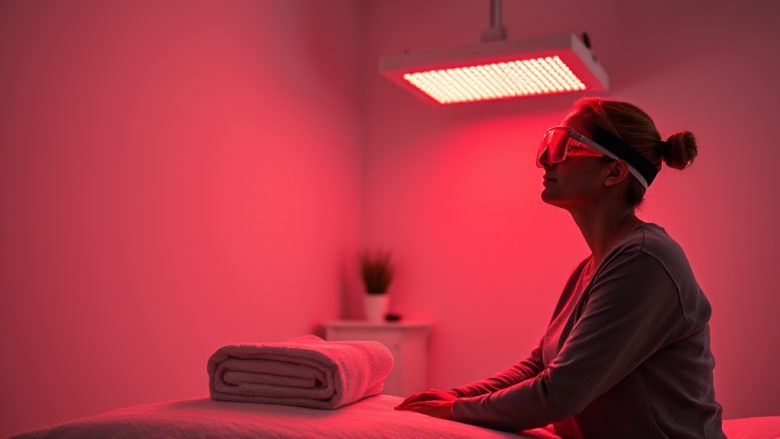
Search for what are the benefits of red light therapy and you’ll find the same list almost everywhere: better skin, faster healing, less pain, more hair, deeper sleep, sharper thinking. The list rarely changes. What changes is how much solid research sits behind each claim, and that’s the part most write-ups skip. Some of these benefits have decades of controlled studies behind them. Others rest on small trials, animal work, or enthusiastic marketing. This article ranks them by how much confidence you can reasonably place in each one, so you finish with a realistic picture rather than another flat list.
Red light therapy — also called photobiomodulation or low-level laser therapy — uses visible red wavelengths (roughly 620 to 700 nanometres) and near-infrared light (roughly 800 to 1100 nanometres) delivered by LEDs or lasers. Near-infrared penetrates deeper into tissue than visible red, which is why the two are often combined in panels and handheld devices. The therapy is non-invasive, generally painless, and has a long safety record at typical doses. That safety is one reason it attracts so many claims: it’s easy to try, and hard to disprove quickly.
How red light is thought to work in the body
The leading explanation is mitochondrial. A specific enzyme in the mitochondria called cytochrome c oxidase absorbs red and near-infrared photons. When it does, it appears to nudge energy production up slightly and trigger signalling that reduces oxidative stress and inflammation. In practical terms, cells in a mildly stressed or injured state seem to respond more than healthy ones — which is why the effects show up most clearly in damaged tissue and less clearly in people who are already well.
That mechanism also explains the ceiling on what the therapy can do. If the primary effect is helping stressed cells recover, then conditions driven by active inflammation or poor local circulation are more plausible targets than, say, general ageing. It’s worth keeping that framework in mind as you read the sections below. The question isn’t whether red light does something in a petri dish; it’s whether that something survives the trip to a real human outcome.
One more thing before the rankings. Dose matters enormously, and more is not better. Studies showing no effect often used doses that were too low, too high, or applied to the wrong spot. When you read a claim, ask what wavelength, what dose, and how many sessions. If those details are missing, treat the claim as unproven rather than false.
Skin and wound healing: the strongest evidence
If you want the benefit with the most consistent research behind it, it’s skin. Multiple controlled trials and reviews support red light for improving the appearance of fine lines, skin texture, and mild scarring, and for speeding the closure of certain wounds. The mechanism fits: skin is directly exposed to the light, so penetration is not a barrier, and the anti-inflammatory and collagen-stimulating effects are measurable.
What does that look like in practice? Typical protocols use visible red wavelengths around 630 to 660 nanometres, applied two to three times a week for several weeks. Improvements tend to be modest — a visible but not dramatic change in texture and tone — and they build gradually rather than overnight. Results fade if you stop, which suggests the effect is ongoing rather than permanent. For wound healing, the evidence is strongest in specific contexts such as diabetic foot ulcers and surgical incisions, where clinicians can control dose and timing precisely.
Confidence: high for skin texture and specific wound types. This is the area where red light has earned its reputation, and where a sceptical reader should feel comfortable accepting the core claim.
Pain and joint conditions: real but narrow
Pain relief is the second most common claim, and the evidence here is genuinely mixed but not empty. The best-supported uses are knee osteoarthritis, chronic neck pain, and some tendon problems. Several randomised trials show meaningful reductions in pain scores compared with sham treatment, though the effects are usually modest and vary a lot between studies.
The catch is that pain is subjective and notoriously responsive to placebo, and many trials are small. The better-designed studies tend to show smaller effects than the early ones. Near-infrared wavelengths around 800 to 900 nanometres are typically used for joint pain because they penetrate deeper than visible red. Sessions are often longer and repeated over weeks.
Where the evidence thins out is in generalised or poorly defined pain — fibromyalgia, widespread back pain, or vague ‘inflammation’ claims. Some trials show benefit; others show none. If you have a specific, localised joint problem, red light is a reasonable thing to try alongside conventional care. If you have diffuse pain, don’t expect much.
Confidence: moderate for specific joint and tendon pain, low for generalised pain.
Hair regrowth: promising, not proven
Hair loss is one of the most heavily marketed uses, and the evidence is thinner than the marketing suggests. There are small trials showing increased hair density in androgenetic alopecia, particularly when red light is used alongside standard treatments like minoxidil. The effect, where it appears, is modest — a slight increase in density rather than a return to a full head of hair — and it requires consistent use over months.
The problem is study quality. Many trials are small, short, and industry-funded, and results are inconsistent. A few well-designed trials show no significant benefit over sham. That doesn’t mean it can’t work for some people, but it means the honest position is ‘possibly helpful, definitely not guaranteed.’
One practical point: if you’re going to try it, give it at least four to six months before judging, and don’t stop other treatments to make room for it.
Confidence: low to moderate. Promising enough to test, not strong enough to rely on.
Sleep, mood, and brain function: the speculative frontier
This is where the claims get interesting and the evidence gets thin. There are small studies suggesting red light exposure — particularly in the morning or via transcranial devices aimed at the forehead — may improve sleep quality, reduce symptoms of depression, and support cognitive function. The mechanisms proposed involve improved mitochondrial function in brain tissue and effects on circadian signalling.
The studies are mostly small, short, and heterogeneous in dose and device. Some show benefits; others show nothing. Transcranial red light in particular is difficult to deliver at adequate doses through the skull, and the devices vary wildly in output. For sleep, the strongest signal seems to come from morning light exposure generally, which is not unique to red wavelengths.
None of this means the claims are wrong. It means they’re unproven. If you’re considering red light for mood or cognition, treat it as an experiment, not a treatment, and don’t replace anything with a stronger evidence base.
Confidence: low. Interesting, preliminary, not yet actionable.
Thyroid, hormones, and other claims: proceed with caution
Beyond the main categories, red light is promoted for thyroid function, hormone balance, weight loss, and immune support. These claims range from plausible-but-unproven to frankly speculative. A few small studies have looked at red light over the thyroid in Hashimoto’s thyroiditis, with mixed results. Hormone and weight-loss claims mostly rest on mechanistic reasoning rather than clinical outcomes.
The pattern here is familiar: a plausible mechanism, a handful of small studies, and a lot of confident marketing. If a claim about red light sounds too broad — ‘balances hormones,’ ‘boosts immunity,’ ‘detoxifies’ — it’s almost certainly ahead of the evidence. That doesn’t make the device useless; it makes the claim unreliable.
Confidence: very low. Not a reason to buy, and not a reason to avoid red light for better-supported uses.
Putting it together: a ranked summary in prose
If you line the benefits up by evidence strength, the order looks like this. Skin texture, mild scarring, and specific wound healing sit at the top — the research is consistent enough to accept. Localised joint and tendon pain comes next: real but modest, best for specific problems rather than general aches. Hair regrowth is third: worth a cautious trial, not worth high expectations. Sleep, mood, and cognitive claims sit near the bottom, supported mainly by small preliminary studies. Thyroid, hormone, and immunity claims sit at the very bottom, where the mechanism is interesting but the human evidence is thin.
A few practical points apply across all of them. Dose and wavelength matter more than brand or price. Consistency matters more than intensity — short, regular sessions beat occasional long ones. And red light works best as an addition to, not a replacement for, treatments with stronger evidence. If you have a medical condition, talk to a clinician before using it on that area, particularly around the eyes or thyroid.
The honest answer to what are the benefits of red light therapy is that it does some things reasonably well, several things modestly, and a lot of things not at all — or at least not yet. Knowing which is which is the difference between using it well and wasting money on hope.
Frequently asked questions
How long does it take to see results from red light therapy?
For skin, expect four to eight weeks of regular sessions before visible change. For pain, some people notice improvement within two to three weeks, but trials typically run six to twelve weeks. Hair takes longest — at least four to six months. If nothing changes after a fair trial at a proper dose, more time probably won’t help.
Is red light therapy safe to use at home?
At typical doses, yes. The main risks are eye exposure (use the provided goggles, especially with near-infrared) and skin irritation from overuse. Avoid treating the thyroid area or over active cancer without medical advice. If you’re pregnant or taking photosensitising medication, check with a clinician first.
What’s the difference between red light and near-infrared?
Visible red light (around 630 to 660 nanometres) works mainly on the skin’s surface and is used for skin concerns. Near-infrared (around 800 to 1100 nanometres) penetrates deeper into muscle and joint tissue, so it’s used more for pain and deeper inflammation. Many panels combine both.
Can red light therapy replace other treatments?
No. It’s best used alongside conventional care, not instead of it. For skin, it complements sunscreen and proven topicals. For joint pain, it complements physiotherapy and appropriate medication. If a seller tells you to stop a prescribed treatment, that’s a red flag.