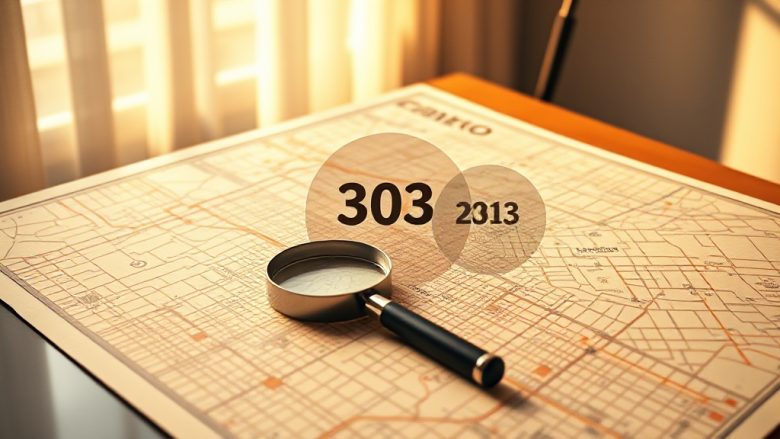
If you’ve ever glanced at an unknown number with 303 at the front, here’s the short answer: 303 is Colorado, and specifically the Denver metro area. It’s one of the oldest area codes still in use in the United States, part of the original batch assigned back in 1947. But the genuinely interesting part isn’t the code itself. It’s what happened around it. Colorado grew, the 303 territory got split, then split again, and eventually overlay codes were stacked on top of the same ground. Understanding 303 today means understanding that whole chain of events.
So if you’re asking what area code is 303, you’re really asking two questions: where does it point, and why does Denver seem to have so many codes layered over the same city? Both have clear answers.
What 303 Covers Today and Where It Came From
Today, 303 serves the Denver metropolitan area, including the city and county of Denver itself, plus much of the surrounding urban core. It’s paired as an overlay with 720 and 983, which cover the same geographic footprint. When you see a 303 number, you’re looking at a line that traces back to the earliest days of the North American Numbering Plan.
In 1947, when area codes were first drawn up, Colorado received three: 303 for the northern and eastern part of the state, 719 for the south, and 970 for the western slope. Denver sat squarely inside 303, which made sense because it was the population centre. For decades, 303 was simply “Colorado” in most people’s minds, at least the Front Range portion of it.
That worked fine until the state’s population started climbing. By the late 1980s, the Denver metro had grown enough that the single code couldn’t keep up with demand for new numbers. So in 1988, the 719 code was carved out for southern Colorado, including Colorado Springs and Pueblo. That took some pressure off, but not enough. In 1995, the northern part of the state, including Fort Collins and Greeley, got its own code: 970. Suddenly 303 was shrinking, and it kept shrinking.
By the late 1990s, 303 had been reduced to roughly the Denver metro area alone. That’s a big change from a code that once covered most of the state’s population. For people who grew up in Colorado, the 303 boundary shifting was a real thing, like watching a familiar map get redrawn.
How 720 and 983 Compare to 303
Here’s where the comparison gets useful. When 303 ran out of room again in the late 1990s, regulators had two choices: split the territory again or overlay a new code on top of the existing one. They chose the overlay. In 1998, 720 was introduced, covering the exact same area as 303. Then in 2021, a third code, 983, joined the party.
So what’s the practical difference between a 303 number and a 720 or 983 number? Almost nothing, geographically. All three point to the same Denver-area territory. The difference is purely about when the number was issued and which pool it came from. A 303 number is likely older, or at least belongs to a block that was assigned earlier. A 720 number came along after 1998. A 983 number is the newest of the three.
That matters in a few small ways. If you’re trying to guess whether a number is a landline or a mobile, the area code alone won’t tell you much anymore. If you’re trying to figure out whether someone is local to Denver, all three codes say yes. And if you’re trying to remember whether you need to dial ten digits, the answer is yes, and it’s been that way since the overlay went into effect.
The overlay approach is common now, but back in 1998 it was still relatively new in Colorado. Splitting a code means some people have to change their numbers, which is disruptive. Overlaying a code means nobody has to change, but everyone has to dial more digits. Regulators decided the second option was less painful. Whether they were right is a matter of opinion, but the result is that Denver now has three area codes sharing one map.
Dialling, Identification and the Practical Side of 303
If you live in or call into the 303 territory, you already know that ten-digit dialling is standard. You can’t just dial seven digits and expect it to work, because the system can’t tell whether you mean 303, 720 or 983. That’s been true since 1998, and it’s not going away.
For identification, the area code still tells you something useful: the number is from the Denver metro. It doesn’t tell you which suburb, which carrier or whether the line is a mobile or a landline. Those details require a lookup, and even then the information isn’t always reliable, especially with number portability. People move, keep their numbers, and switch carriers without changing the area code.
One thing worth knowing: 303 numbers are sometimes seen as “classic Denver” numbers, partly because they’ve been around so long. If you’re a business trying to look established, a 303 number carries a certain weight. If you’re just trying to reach someone, it doesn’t matter at all. The call connects either way.
Scams are another angle. Because 303 is a familiar code, scammers sometimes spoof it to make calls look local. If you get a call from a 303 number you don’t recognise, that doesn’t mean it’s from Denver. Caller ID spoofing is easy and common. Treat unknown numbers with the same caution you would anywhere else.
Frequently Asked Questions About Area Code 303
Is 303 still a Colorado area code?
Yes. 303 remains in active use across the Denver metropolitan area. It’s one of three overlay codes serving that territory, alongside 720 and 983. New numbers are still issued in all three pools, so you’ll continue to see 303 numbers in circulation.
What city is area code 303?
Denver is the primary city, but the code covers the wider metro area, including communities like Aurora, Lakewood, Littleton, Englewood and Westminster. If you’re looking at a map, think of the urban core and the inner suburbs, not the entire state.
Do I need to dial 303 when calling within Denver?
Yes. Because of the overlay, ten-digit dialling is required for all local calls within the 303, 720 and 983 territory. You dial the area code plus the seven-digit number, even if you’re calling someone across the street.
Why does Denver have three area codes?
Population growth and demand for new numbers. The original 303 territory was split twice, in 1988 and 1995, leaving a smaller Denver core. When that core ran out of numbers, overlays were added: 720 in 1998 and 983 in 2021. Overlays avoid forcing existing customers to change their numbers.
Is 303 a mobile or landline code?
Neither. Area codes don’t indicate whether a number is mobile or landline. That distinction disappeared with number portability, which lets people keep their number when switching carriers or moving. A 303 number could be either.
So the next time you see 303, you’ll know it’s Denver, you’ll know it’s one of the oldest codes still working, and you’ll know it shares its ground with two newer overlays. That’s a lot of history packed into three digits.